Fossil CO2 Emissions: European Union, United States and China (Per capita and Total)
/2025/ The graphs below show the Fossil CO2 Emissions in tons Per capita from EU-27 in comparison to the United States, China and global emissions. Chinese emissions Per capita exceeded the global average around 2004 and EU-27 around 2011.
Global Indicator Updates 2025: Global Temperature, CO2 content in the Atmosphere and Population
/2025/ The three Global Indicators included in the calculations of Climate Debt in ClimatePositions are: 1) Global Temperature, 2) CO2 content in the atmosphere, and 3) Global Population. In 25 years these three indicators have caused a decrease in the Fossil CO2 Emission Reduction Target from 1.00 ton to 0.55 ton – by 2059.
Global indicator updates: Land-Ocean Air Temperature, Sea Level, CO2 in the Atmosphere and Population
2019
The four global Indicators: 1) Land-Ocean Air Temperature, 2) Sea Level, 3) CO2 in the Atmosphere and 4) Population, have all been updated in ClimatePositions. Combined, the updates resulted in significant increases in national Climate Debts (the first two, due to adjustments of the national GDP-Factor and the last two, due to adjustments of the global Fossil CO2 Emission target). As an example, India’s Climate Debt increased from $0.30 per capita (rounds to zero), to $2 per capita, only because of the global Indicator updates.
Diagrams with the four global Indicators are shown below.
Study: National climate pledges and the resulting Global Warming by 2100 (The Pledged Warming Map)
2018
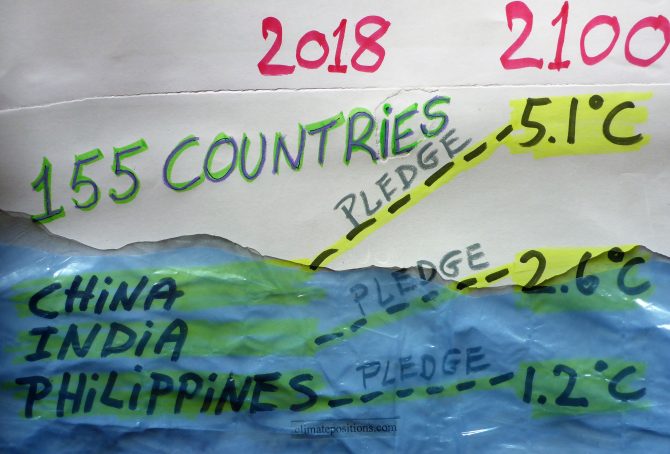
The Paris Agreement collectively committed the countries to limit Global Warming to well below 2°C and pursue efforts to limit warming to 1.5°C above preindustrial levels. However, how much Global Warming by 2100 is each country’s climate pledge leading to, if all countries adopted the same national approach and ambition? This question is being tried answered for the world’s countries on the new website ‘paris-equity-check.org‘ (Pledged Warming Map). The underlying ‘Peer-reviewed study‘ is published November 2018 in Nature Communications.
The site says: “The Paris Agreement includes bottom-up pledges and a top-down warming threshold. Under this setting where countries effectively choose their own fairness principle, Paris-Equity-Check.org presents scientifically peer-reviewed assessments the ambition of countries’ climate pledges (the Nationally Determined Contributions or NDCs) and address the question: What is a fair and ambitious contribution to achieving the Paris Agreement?” Read ‘Ambition of pledges‘ and ‘The science‘.
The table below shows 155 countries’ 1) ‘Per capita Climate Debt‘ in 2017, accumulated since 2000 in ClimatePositions, 2) per capita Fossil CO2 Emissions 2016, and 3) the pledges estimated effect on Global Warming by 2100 (Pledged Warming Map).
IPCC Report: Limiting Global Warming to 1.5ºC requires 45% CO2 reductions by 2030 compared to 2010 – and zero emissions by 2050 (but which countries are to reduce how much per capita?)
2018
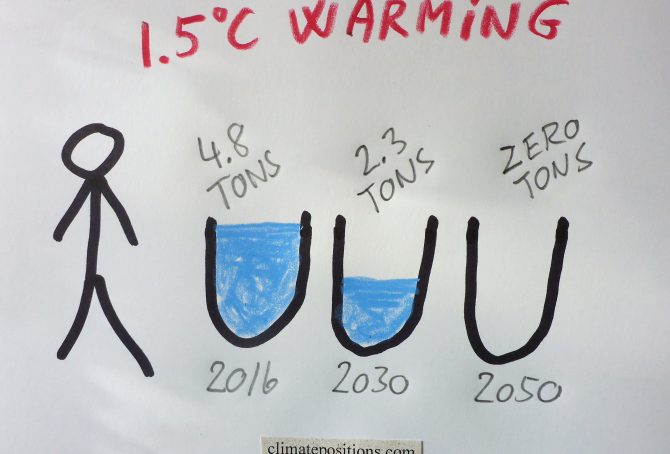
The IPCC Report ‘Global Warming of 1.5°C‘ released October 2018, finds that limiting global warming to 1.5°C would require reductions of global human-caused CO2 Emissions (carbon dioxide) of 45% by 2030 compared to 2010, and reach zero emissions around 2050¹.
However, since global Fossil CO2 Emissions increased 6.4% between 2010 and 2016, and the world population is expected to grow 1.2% annually the years to come, the required 45% global CO2 reductions by 2030, is equivalent to 53% reduction per capita by 2030 compared to 2016, or in only 14 years. In other words, an average world citizen must cut Fossil CO2 Emissions from 4.8 tons in 2016 to around 2.3 tons by 2030 and zero by 2050 (if limiting global warming to 1.5°C). Note that forest cover growth, removing CO2 from the air, etc. can substitute Fossil CO2 reductions in the IPCC scenarios².
Countries with upcoming or de facto Climate Debts
2018
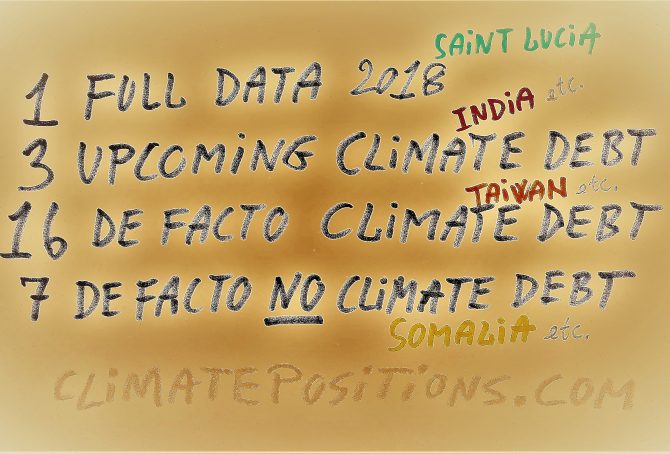
Among 164 countries with full data in ClimatePositions 91 have Climate Debts. Note that Saint Lucia is new on the full data country-list with an accumulated per capita Climate Debt of $287. India, Lithuania and Latvia are likely to have small Climate Debts soon … by 2018 or 2019.
In addition to the full data country-list, 16 countries with lack of indicator data would have Climate Debts with roughly estimated data¹. The estimated per capita Climate Debts of these countries are:

Indicator update: Environmental Performance Index 2018
2018
The Environmental Performance Index 2018 ranks 180 countries on 24 performance indicators across 10 issue categories¹ covering A) Environmental Health (40%), which measures threats to human health, and B) Ecosystem Vitality (60%), which measures natural resources and ecosystem services. Over the years the Environmental Performance Index (EPI) has also identified a number of severe data gaps² that hamper sustainability goals.
Global indicator updates: Land-Ocean Temperature, Sea Level, CO2 in the Atmosphere and Population
2018
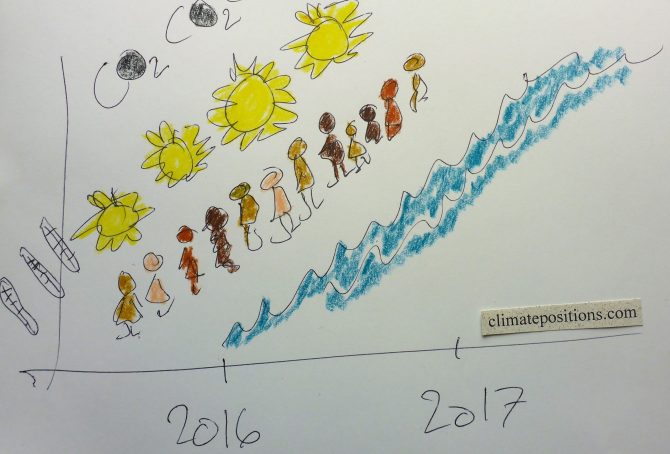
The four global Indicators: Land-Ocean Temperature, Sea Level, CO2 in the Atmosphere and Population have been updated in ‘ClimatePositions (Excel)‘. Combined, the updates resulted in significant increases in national Climate Debts. Land-Ocean Temperature and Sea level due to adjusting the national GDP-Factor, while CO2 in the Atmosphere and Population due to adjusting the global Fossil CO2 Emission Target.
Diagrams with the four global Indicators are shown below [diagram were replaced 15-02-2018].
Updated Climate Debt of 163 countries (per capita Fossil CO2 Emissions 1990-2016)
2017
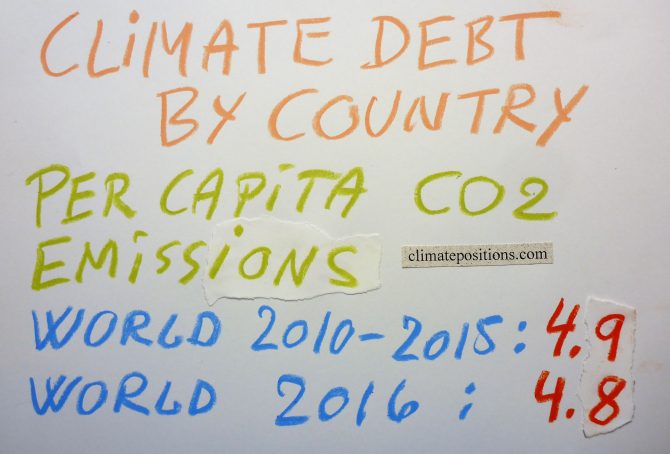
National per capita CO2 Emissions from Fossil Fuels (without bunkers) and industrial processes in 2016 have been released by ‘EDGAR‘. At the same time, recalculated historic emissions have been released, which for some countries make a considerable difference¹ (also with regard to Climate Debt in ClimatePositions). The updated calculations are available in ‘Calculation (Excel)‘, and new rankings of 163 countries are available in the menu “Climate Debt”.
The table below shows World average, and the 15 countries with the largest per capita CO2 Emissions from Fossil Fuels and industrial processes in 2016, in tons, in comparison with average emissions 1990-1999, 2000-2009 and 2010-2015.
Two studies: 26-year soil warming experiment in a mid-latitude hardwood forest (possible self-reinforcing carbon emissions feedback loop) and 12,000 years of soil carbon losses from agriculture
2017
In continuation of the previous article about aboveground forest carbon losses, the following is about soil carbon losses due to warming and agriculture, respectively.
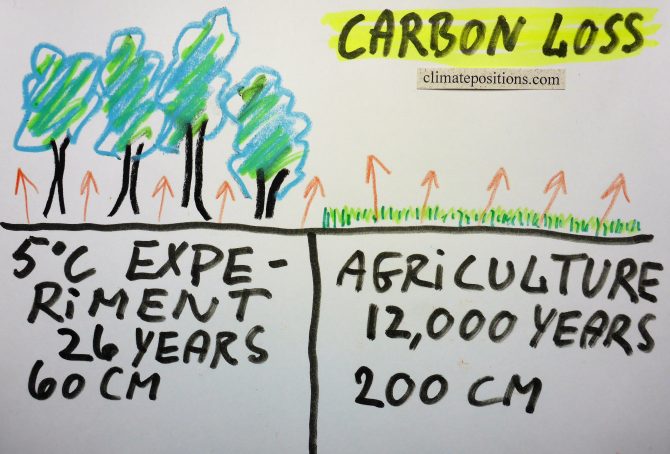
Melillo et al. performed a ‘26-year soil-warming experiment‘ in a mid-latitude mixed hardwood forest with results published October 2017 in the peer-review journal Science. Some forest areas (plots) were heated up with underground cables to 5°C above normal levels, while other forest areas were left as a control. The experiment then documented changes in soil carbon cycling in the top 60 cm and investigated the possible consequences for the climate system.
Study: Tropical forests now release twice as much carbon than they absorb
2017
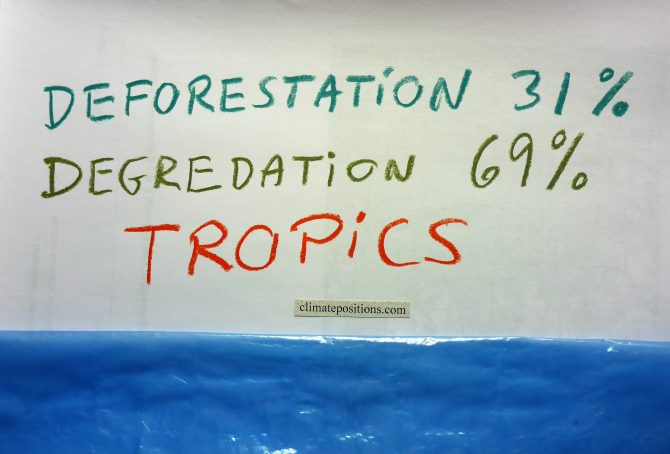
A new ‘Study‘ from ‘Woods Hole Research Center‘ and Boston University reveals tropical forests now emit twice as much carbon than they capture. This is alarming news, since forests are the only carbon capture and storage “technology” that is safe, inexpensive and immediately available.
New approach to measuring forest carbon density using 1) satellite imagery 2003-2014, 2) laser remote sensing technology and 3) field measurements, were able to capture aboveground losses in forest carbon from full-scale deforestation as well as fine-scale degradation and disturbance. The latter has previously been a challenge to the scientific community over large areas. According to the study tropical forests in Americas, Africa and Asia are now releasing 425 (± 22%) teragrams (million tons) of carbon annually¹, equivalent to more than 4% (calculated by me) of global CO2 Emissions from Fossil Fuels and industrial processes. For perspectivation, global CO2 Emissions dropped 0.34% in 2016 compared to 2015.
UN Sustainable Development Goals (Global Goals) and greenhouse gas emissions
2017
UNs 17 ‘Sustainable Development Goals‘, or Global Goals, consist of simple headings with underlying ‘Clarifications and indicators‘ (pdf, 25 pages) that interact with each other in complex ways. The following examines the links between The Global Goals and greenhouse gas emissions.
Global Goal 13: “Take urgent action to combat climate change…”. The action is indicated by the number of countries that have communicated (..) an integrated policy/strategy/plan which increases their ability to (..) foster (..) low greenhouse gas emissions development in a manner that does not threaten food production.
In other words, the key action-instrument to ensure that global temperatures rise no more than 2°C is national plans to promote low emissions without reducing food production. Consequently, all goals related to food production will have to be included the survey.

Indicator update: Nuclear Power 2016
2017
In ClimatePositions Nuclear Power generation is not accepted as a national CO2 Emission reduction instrument and the generation must be phased out parallel to CO2 Emissions from Fossil Fuels and cement production¹.
The table below shows the Nuclear Power generation in billion kWh in 2014, 2015 and 2016, of all 32 countries and the world. The global generation 2016 was 2% higher than in 2015. However, the increase was caused sole by China’s 49% increase.

Indicator update: Ecological Footprint 2017 (without Carbon Footprint)
2017
The updated per capita Ecological Footprint¹ for 192 is available for licensing by ‘Global Footprint Network‘ (Public Data Package – Free Download). The average Ecological Footprint without the weighty Carbon Footprint², since 2005, is used as an ‘Indicator‘ in ClimatePositions when calculating national Climate Debts. The footprint-indicator includes: 1) Built-up Land, 2) Cropland, 3) Grazing Land, 4) Forest Product and 5) Fishing Ground, all allocated to the consumption components of Food, Shelter, Mobility, Goods and Services.
The relative per capita Ecological Footprints without carbon, over time, of the ‘90 countries with Climate Debt‘ are shown in the table below. An average country among 172 countries in ClimatePositions is set at 100. Note that the data-year is about 4 years prior to the release year.
ClimatePositions has been updated with Fossil CO2 Emissions data from EDGAR
2017
As announced in the previous ‘Article‘ the calculations of Climate Debt by country in ClimatePositions has now been updated with CO2 Emissions data from ‘EDGAR‘ (European Commission), instead of data from Global Carbon Project (CDIAC).
At the same time, the global CO2 target has been raised by 0.2 tons per capita by 2025, and the indicators of Ecological Footprint (without carbon) and GDP (ppp-$) 2016 have been updated as well. New updated rankings are available in the menu “Climate Debt” above. Updated data and diagrams with all ‘Indicators‘ and all countries are available in the submenu ‘Calculations (Excel)‘.
The table below shows the new ranking of 163 countries in comparison with the previous (last) ranking (159 countries) with emission data from Global Carbon Project (CDIAC). No Climate Debt is marked “free”. Only Montenegro is excluded from the new ranking due to missing CO2 Emission data (ranks 69th in the previous ranking).
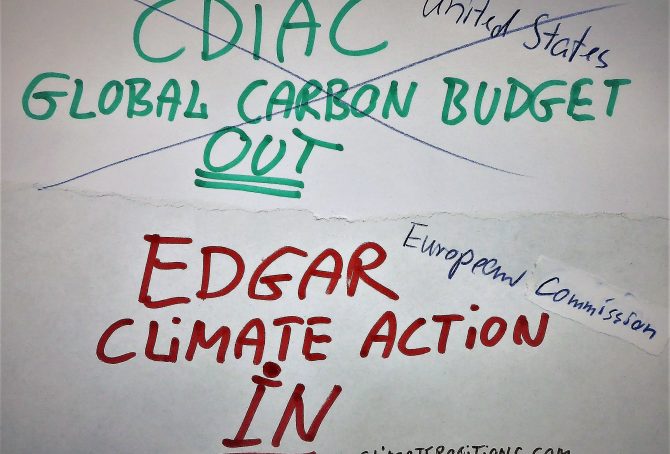
Global Carbon Project (CDIAC), located in the United States, stops publishing carbon emissions data by country – will be replaced by EDGAR in ClimatePositions
2017
The Carbon Dioxide Information Analysis Center (CDIAC), located at the U.S. Department of Energy’s (DOE) Oak Ridge National Laboratory, has published annual Carbon Emissions from Fossil Fuels and cement production by country since 1959 (‘Global Carbon Project‘), but now this continuous time series has come to an end and 2015 will be the last data-year (as it seems).
Since carbon emissions data from CDIAC (Global Carbon Project) is the core ‘Indicator‘ in ClimatePositions’ calculation of Climate Debt, carbon emissions data will be replaced with nearly similar data from ‘EDGAR‘ (‘European Commission‘ / ‘Climate Action‘), retroactively since 1990, in connection with the coming updates [done 16-08-2017].
The following describes the differences between CO2 Emissions data from Global Carbon Project (CDIAC) and EDGAR (sourced: European Commission, Joint Research Centre (JRC)/Netherlands Environmental Assessment Agency (PBL). Emission Database for Global Atmospheric Research (EDGAR)), and the consequences in terms of Climate Debt in ClimatePositions – illustrated with a range of country examples. Note that other sources, such as ‘IEA‘, ‘EIA‘ and ‘BP‘, provides CO2 Emissions data-sets different from the ones of CDIAC and EDGAR.
Climate change performance: 62 countries without Climate Debt (compared to Boycott Group A & B)
2017
Only 62 countries among 159 with full data in ClimatePositions are without Climate Debt (see the ‘Ranking‘). The 62 countries (Group-62) are in alphabetic order: Afghanistan, Azerbaijan, Bangladesh, Benin, Bhutan, Burkina Faso, Burundi, Cambodia, Cameroon, Central African Rep., Chad, Colombia, Comoros, Congo (Brazzaville), Costa Rica, Côte d’Ivoire, Cuba¹, Dem. Rep. Congo, El Salvador, Eritrea, Ethiopia, Gambia, Georgia, Ghana, Guinea, Guinea-Bissau, Haiti, Kenya, Kyrgyzstan, Laos, Latvia, Liberia, Madagascar, Malawi, Mali, Mauritania, Moldova, Mozambique, Namibia, Nepal, Nicaragua, Niger, Nigeria, Pakistan, Paraguay, Philippines, Rwanda, Senegal, Sierra Leone, Singapore, Solomon Islands, Sri Lanka, Sudan, Swaziland, Tajikistan, Tanzania, Timor-Leste, Togo, Uganda, Yemen, Zambia and Zimbabwe.
The table below shows Group-62s combined share of the world’s 1) Population, 2) Forest Cover, 3) Primary Forests, and 4) CO2 Emissions from Fossil Fuels (without bunker) and cement production.
Indicator updates: GDP-ppp 2016 and Climate Change Financing (now only Multilateral Funds)
2017
2016-updates of national per capita GDP(ppp-$) from ‘World Bank‘ is now available in ‘Calculation (Excel)‘. The world’s average per capita GDP(ppp-$) grew from $15,668 in 2015 to 16,136 in 2016 (3.0% growth). The diagram below shows the development in per capita GDP(ppp-$) 2000-2016 of the world’s five largest per capita emitters of CO2 from Fossil Fuel and cement: Qatar, Trinidad and Tobago, Kuwait, Bahrain and Brunei; in comparison with the world average.
Climate change performance: Venezuela vs. Iraq (world’s proven reserves of oil and natural gas)
2017
Venezuela holds the world’s largest proven oil reserves and the 8th largest proven natural gas reserves, while Iraq ranks 5th on oil and 12th on gas. Together, the two countries hold nearly 27% of the world’s proven reserves of oil and 5% of its natural gas.
The two tables below rank the 15 countries with the largest proven oil and natural gas reserves and their world shares. Combined, the 19 Fossil Fuel countries listed below hold 93% of the world’s proven oil reserves and 88% of the proven natural gas reserves. They represent 38% of the global population, 62% of the global CO2 Emissions from Fossil Fuels (2015) and 74% of the current global Climate Debt in ClimatePositions (the combined share of the global Climate Debt of the 15 countries has increased by 3.6% since 2012; see the ‘Ranking‘.
World CO2 Emissions 2000-2059: with 50% risk of 2C global warming (two per capita emission-scenarios for the United States, Denmark, Spain, China, India and Nigeria)
2017
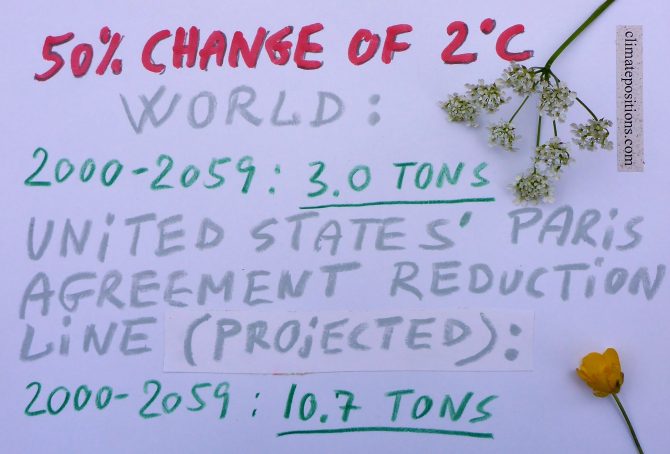
In continuation of the previous article ‘Carbon Brief: Global Carbon Budget and CO2 Emission scenarios (50% risk of 1.5°C, 2.0°C and 3.0°C warming)‘, the following examines the per capita CO2 Emission budget 2000-2059, with a 50% risk of 2°C global warming (which of course is unacceptable). The outcome is then compared with Climate Debt Free CO2 Emission levels (in ClimatePositions) of the United States, Denmark, Spain, China, India and Nigeria, during the same 60-year period. Also, the Paris Agreements reduction commitment of the United States is put into perspective.